
International Day for Countering Hate Speech | June 18, 2026
Today, the world pauses to observe the International Day for Countering Hate Speech, and the theme chosen by the United Nations could not be more urgent or more sobering: “Hate Speech and Artificial Intelligence Nexus: Building Coalitions to Reclaim Inclusive and Secure Environments Free of Hatred.”
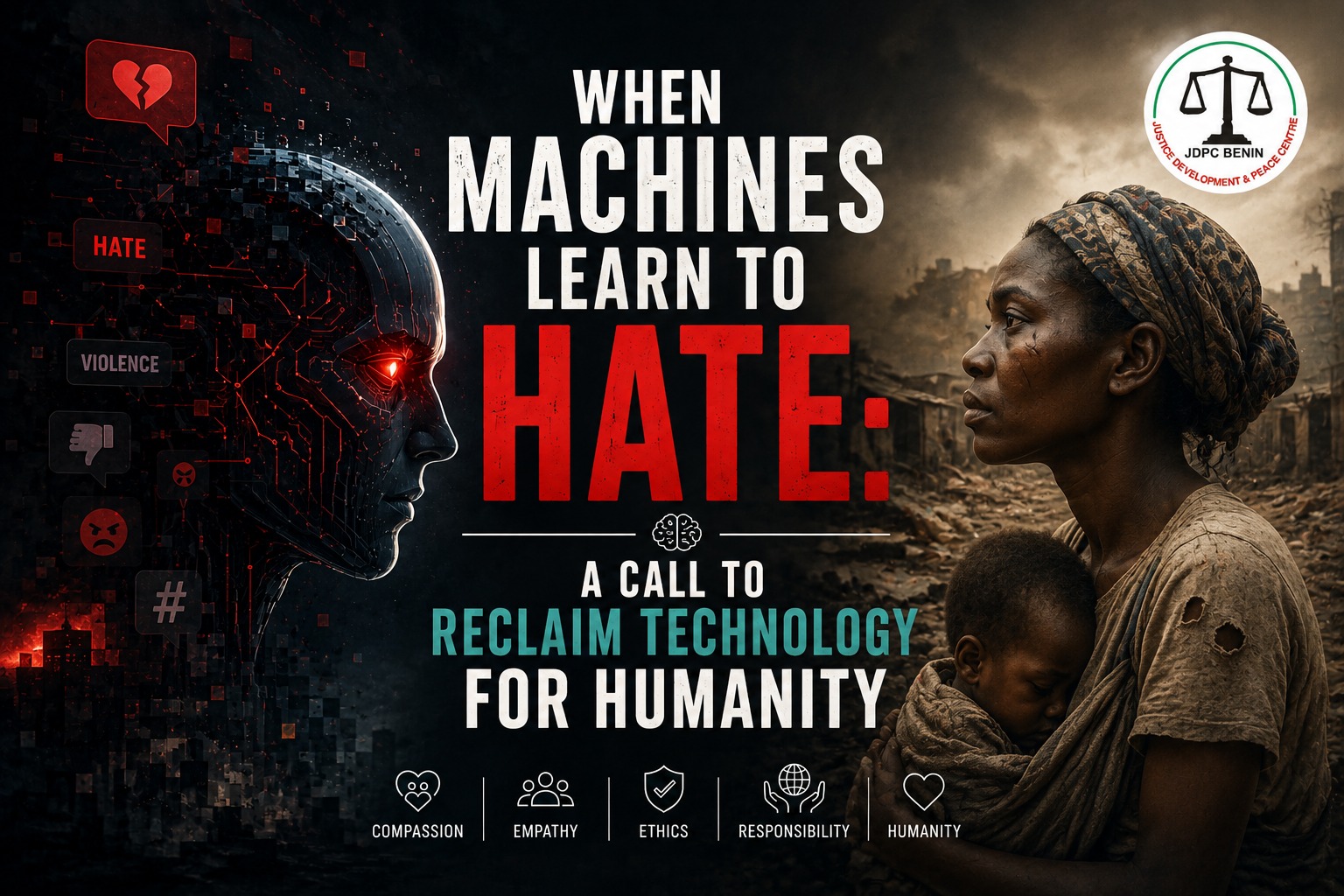
I write as a priest, a human rights advocate, a peacebuilder, and an African. Someone who has seen, up close, how words weaponised become communities destroyed, how narratives twisted become lives shattered. And I write with a growing alarm about the new frontier on which this ancient war is now being fought: the frontier of Artificial Intelligence.
UN Secretary-General António Guterres was direct and unsparing in his message for this day. He called hate speech “the first step down the path of dehumanisation”. A tool wielded to target women, migrants, refugees, persons with disabilities, religious minorities, and countless others, often for cynical political gain.
But what makes this moment uniquely dangerous is the velocity and scale of the problem. As the Secretary-General warned, “In our digital age, hate speech spreads faster than ever, amplified by unregulated platforms and intensified by artificial intelligence. Too many algorithms reward outrage and division, incentivising lies for likes and promoting violence for views.”
This is not a distant, abstract threat. This is the reality playing out on smartphones held in the hands of young people across Africa, Asia, Latin America and Europe. Algorithms that are designed to maximize engagement have discovered, with chilling efficiency, that hatred engages. Fear engages. Outrage engages. Therefore, the machine feeds us more hatred, more fear, more outrage until social trust collapses, communities fracture, and violence becomes thinkable.
We have seen it in election seasons. We have seen it in religious conflicts. We have seen it in the targeting of women and girls with deepfake videos and other AI-generated sexual content designed to humiliate, silence, and destroy. The United Nations Population Fund (UNFPA) has raised the alarm: AI is heightening risks especially for women and girls, accelerating the creation and spread of false and manipulated content that compounds stigma and threatens decades of hard-won gains on gender equality.
This is not the promise of technology. This is its betrayal.
At this critical juncture, the voice of the Catholic Church and indeed, of every faith community has never been more needed. And it has never been more timely.
On May 25, 2026, His Holiness Pope Leo XIV released his landmark first encyclical, Magnifica Humanitas (Magnificent Humanity) On Safeguarding the Human Person in the Time of Artificial Intelligence.” Signed on May 15, 2026, the 135th anniversary of Pope Leo XIII’s historic Rerum Novarum which addressed the injustices of the first industrial revolution, this new encyclical positions the Church at the very centre of humanity’s conversation about what kind of technological world we are building.
Pope Leo XIV did not come to condemn technology. He came to call technology back to its deepest purpose: the service of the human person.
Drawing on the rich tradition of Catholic Social Teaching from Rerum Novarum through Centesimus Annus to Laudato Si’, the encyclical confronts what the Pope calls the technocratic paradigm: the dangerous tendency to allow technological capability to outpace moral wisdom, to allow what can be done to eclipse what ought to be done.
Magnifica Humanitas advances five foundational principlesthat must govern our engagement with AI:
- Human Dignity— every person is made in the image and likeness of God (Imago Dei), and no algorithm, no platform, no profit motive can override this fundamental truth.
- The Common Good — technology must serve the flourishing of all, not merely enrich the few or empower the powerful.
- The Universal Destination of Goods — the benefits of AI must not become the exclusive property of transnational corporations or wealthy states. All of humanity has a claim to the fruits of human creativity.
- Subsidiarity — decisions about AI governance must be made at the most appropriate level, respecting communities and individuals, not concentrated in the hands of a faceless few.
- Solidarity— we are not competitors in a digital race; we are brothers and sisters in one human family, and our technologies must reflect that bond.
The High Representative of the UN Alliance of Civilisations, speaking at the Fifth International Day for Countering Hate Speech, explicitly referenced Magnifica Humanitas, affirming that the encyclical’s challenge to the technocratic paradigm and its insistence on these five principles is precisely the ethical compass our digital age requires.
Pope Leo XIV echoes his namesake predecessor: just as Leo XIII refused to leave the industrial worker to the mercy of unregulated capital, Leo XIV refuses to leave the digital citizen and especially the most vulnerable to the mercy of unregulated algorithms.
In Nigeria and across much of sub-Saharan Africa, the intersection of hate speech and AI is not merely a theoretical concern. It is a lived emergency.
Social media platforms operating in our languages and communities are poorly moderated. AI tools for detecting hate speech are trained primarily on English and European languages, leaving Igbo, Yoruba, Hausa, Pidgin, and hundreds of other local languages functionally unprotected. During election cycles, AI-generated disinformation circulates at frightening speed, stoking ethnic and religious division. Women political candidates face coordinated online harassment campaigns. Religious communities (Christians and Muslims alike) are targeted with manufactured incitement.
At the Justice Development and Peace Centre (JDPC) Benin City, we witness these dynamics in our work on peacebuilding, gender-based violence prevention, child protection, and anti-human trafficking advocacy. The digital sphere is no longer separate from the communities we serve. It is those communities. What happens online has immediate, concrete, and deadly consequences offline.
We cannot afford to be bystanders to the digital transformation. As advocates for justice and peace, we must be in the room where these decisions are made.
I am under no illusion that speeches alone will turn the tide. Nevertheless, I believe deeply that moral clarity, institutional courage, and collective action can. Here is where I believe we must focus our energy:
- Demand Ethical AI Governance
- Governments must act. States have clear obligations under international law to combat incitement to hatred. The UN Strategy and Plan of Action on Hate Speech and the Global Principles for Information Integrity provide roadmaps. Civil society, faith communities, and academia must hold governments and technology companies accountable to these frameworks. What is illegal offline must be illegal online.
- Centre Human Dignity in AI Design
- Technology companies must go beyond profit metrics. Safety, dignity, and privacy must be embedded in the architecture of platforms not added as afterthoughts when public pressure forces them to act. Pope Leo XIV is right: the question is not what machines are capable of doing. The question is whether technological innovation remains anchored in the values that bind our societies together.
- Build African and Global South Capacity
- Technology companies must go beyond profit metrics. Safety, dignity, and privacy must be embedded in the architecture of platforms not added as afterthoughts when public pressure forces them to act. Pope Leo XIV is right: the question is not what machines are capable of doing. The question is whether technological innovation remains anchored in the values that bind our societies together.
- Invest in Education and Digital Literacy
- Young people must be equipped to recognise and reject hate speech. Critical thinking, media literacy, and digital citizenship must be integrated into education from primary school onward. The UN Secretary-General is right: education is among the most powerful tools we have to break the dangerous cycle.
- Build Coalitions Across Difference
- The theme of this year’s observance speaks of building coalitions. Churches, mosques, temples, schools, universities, civil society organisations, and government institutions must work together. No single actor has the reach, the moral authority, or the technical capacity to address this challenge alone. In Nigeria, the Christian Association of Nigeria (CAN), the Pentecostal Fellowship of Nigeria (PFN), the Catholic Secretariat, the Nigerian Supreme Council for Islamic Affairs, and interfaith platforms must forge a common front against digital hatred.
- Protect the Most Vulnerable
- Women and girls, migrants and refugees, persons with disabilities, minority religious and ethnic communities those most targeted by AI-amplified hate speech must be at the centre of our response. Policies designed without them will fail to protect them.
As a priest, I cannot conclude without speaking from the deepest well of my conviction.
The God we worship, the God of Abraham, of Isaac, of Jacob, the God revealed fully in Jesus Christ, is a God who declared that every human being bears a dignity that no power on earth can strip away. The Incarnation God taking on human flesh, entering human history, dwelling among the poor and the marginalised is the ultimate proclamation that humanity is magnificent.
Pope Leo XIV has named it well. We are called, in this technological age, to choose: will we build a new Tower of Babel, a monument to human arrogance, where the powerful use their tools to confuse, divide, and dominate? Or will we build the city where God and humanity dwell together where technology serves truth, where innovation lifts the vulnerable, where the dignity of every person is not just proclaimed but protected?
The answer to that question is not written in the code of any algorithm. It is written in the choices we make today as citizens, as leaders, as believers, and as human beings.
Hate speech, whether spoken by a human tongue or generated by a machine, remains what it has always been: a lie about the value of another person. And the antidote to a lie is not silence. It is courage the courage to speak the truth, to name the harm, and to build, together, something better.
Let us commit, on this International Day for Countering Hate Speech, to using Artificial Intelligence not as a tool of hate, but as a force for good.
As Pope Leo XIV has challenged the world in Magnifica Humanitas, let the magnificence of our humanity be the measure by which we judge every technology we create.
Rev. Fr. Benedict O. Onwugbenu is the Executive Director, Justice Development and Peace Centre (JDPC) Benin City, Edo State, Nigeria.